Mark "Jake" Baker
Peace and Conflict Studies
University of California
Berkeley, CA
November 18, 1997

INTRODUCTION
At the beginning of this incredible decade, I remember hearing much talk about the glorious coming of age of a "New World Order" due to the process called "globalization." According to the rhetoric, the introduction of a market economy and democratic principles into a host of newly formed countries and older, well-established countries was creating one big Global Community. Indeed, the 1990’s began with some events of absolute wonder. We in "The West" rejoiced when we witnessed the fall of the Berlin Wall, the collapse of the Soviet Union, and the United States’ (with the support of the United Nations) expeditious victory in Operation Desert Storm. In addition, new technologies in communications further helped break down the borders. Therefore, transnational corporations increased trade within the global marketplace, and citizens across the globe began to chat for the price of a local telephone call.
However, while some may boast that a New World Order is knocking down the remains of the walls of history—others point to ample evidence that suggests that history has been merely repeating itself. Evidence continues to mount to this day that anti-Western "rogue" nations are attempting to build nuclear weapons and intercontinental ballistic missiles. The same UN that flexed its muscles in Iraq stood by and watched as civil war broke out in the multiethnic former Yugoslavia—Eastern Europe’s most prosperous country—leaving tens of thousands of its people dead and 3.7 million displaced. Many nations are forming economic alliances to increase their competitiveness in the world economy and therefore counter the dominance of Japan, the U.S., and Germany. As they seek to protect their interests, and the search for scarce resources intensifies, those who promote the repeat of history claim that it is inevitable those militaries will clash.
Then again, and perhaps even worse, others point to evidence that suggests that there is indeed a New World Order, but that it is already showing signs of weakness. Globalization of the world’s economy is causing rising unemployment and greater unequal distribution of income problems. Corporations are restructuring themselves, moving manufacturing abroad, and exporting domestic jobs to foreign subcontractors. A typical corporate executive now earns 200 times what the average worker makes. The results are sweatshop conditions in 3rd World countries and higher unemployment rates in the West. Real people are paying the price for unequivocal growth and prosperity. In addition, there is solid evidence of global warming, industrial pollution, ozone depletion, the spreading of deadly diseases and other environmental catastrophes. Mismanaged globalization is threatening our very survival.
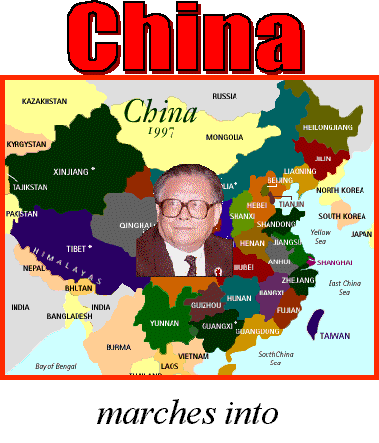
Now that the 1990’s are nearly over, yet another event of monumental proportions and repercussions begs us to ponder the effect of globalization upon world history in the new millenium. During the first week of November, President Clinton and Corporate America rolled out the red carpet to perhaps the United State’s largest formidable threat to the security of "The New World Order." It also happens to be the biggest untapped commercial market for U.S. products. This would be, of course, Communist Red China. The first college-educated President of China, Jiang Zemin, visited the United States to embark upon a grandiose promotional tour. He seeks desperately to modernize his economy. China has spent too many years in near isolation, trying to go it alone. A backward country, Zemin knows it needs to catch up. This visit is only one of many bids he will make to Western nations to enroll his country into the exclusive club known as "The New World Order."
The ramifications of the so-called U.S.-China summit on the integration of China in the global community had political theorists scrambling for the presses—and they are having a field day. Will China be seduced by capitalism, embrace Western ideology, and then naturally convert from dictatorship to democracy? Will the Chinese government simply pocket all the profits of a global economy at the expense of both the people and the landscape? Will China betray the West’s trust and continue on a path to regional dominance and nuclear weapons proliferation? Will China eventually to come to blows with its neighbors and the West after increasingly heated interactions between the different cultures flare and ancient rivalries erupt? Will China suffer from ethnic squabbles within, and eventually self-destruct and splinter into many smaller nation-states? Will pressures from non-governmental organizations (NGOs) and rights activists eventually turn around China’s deplorable record of abuse upon its people and therefore prevent the profiteers of globalization from raping them and their environment? There is no way to know for sure—but will certainly make for one hell of a debate for years to come.
In this essay, I intend to concentrate on analyzing the issues of security and development within the context of the issues addressed in and around the U.S.-China Summit. The current position towards China embraced by our administration and businessinterests is clearly the liberalism viewpoint and concentrates on economic development. On the other hand, surviving members of the Bush administration still operating in Washington, many Republicans, and their supporters strongly uphold the realist’s viewpoint, which concentrates on security issues. Finally, many NGOs, individual actors, and their supporters concentrate on development in the context of human evolvement and thus the protection of the rights of the Chinese people and their environment.
 The Tour
Such red carpet treatment by the Clinton administration of anyone representing communist Red China would have been unthinkable just a few short years ago. It was less than ten years ago that Red Chinese PLA tanks mowed down dissident students in Tiananmen Square—killing perhaps thousands and jailing hundreds more. President George Bush could not even get his "old friend" Deng to speak with him. Since that time, China accumulated a full plate of reported abuses of human rights.
Clinton himself accused Bush of coddling China during the 1992 campaign. Then, the 1995 standoff in the Taiwan Straits brought relations to a boiling point as Clinton sent two aircraft carriers to scare off the Chinese. Currently, there are still the uncertain Chinese intentions in regards to Hong Kong as well as accusations of illegal interference in U.S. domestic politics.
Therefore, the tour attracted many protesters touting such diverse issues as human rights abuses, forced-abortion population control, Christian persecution, the jailing of political prisoners, and national security. All tried to hail down Zemin—albeit with great difficulty—wherever he trod. Showing support for their constituents, Congresswomen and men gave further voice by proposing seven strict bills supporting some of those very issues.
The Goals
The intentions behind the tour are unique. This is the first time that a functioning and growing communist country has opened its arms to Western investment in an all out effort to modernize its economy. (Russia does not fit into this category because it was already on the verge of collapsing when it came to The West for help.) Perhaps acting out of desperation, President Zemin stated more than once on his tour that he is responsible for ensuring "that the1.2 billion Chinese people have adequate food and clothing." China wishes to modernize by attempting to integrate market principles within a centralized communist dictatorship that pays lip service to socialist ideals. In his own country, analysts call him an "opportunist because he is bereft of any ideological belief." His "anything goes" philosophy will serve him well in his efforts to modernize the Chinese economy—but only for a price. Zemin will have to bargain and make concessions with the West and sell his ideas to communist hard-liners. Then, China will need to do some serious internal restructuring—towards privatization. Indeed, Mao must be rolling in his grave.
To be specific, President Zemin came to the U.S. to settle differences that would allow his country access to superior U.S. nuclear technology for commercial use. He wants to purchase the materials and expertise to install two reactors to produce energy. While he was here, he also cut other grandstanding business deals with U.S. corporations like Boeing and Ford.
The U.S. had lofty concessions in mind for President Zemin. First, to end Chinese sales of weapons and nuclear technology to Iran and Pakistan. Second, to obtain the release of dissidents held in Chinese jails. Third, to pressure China to improve its human rights record. Fourth, to reduce trade barriers to ease the huge trade deficit.
The Results
In the end, China signed a promise not to engage in any "new nuclear cooperation" with Iran and to stop selling Iran C-802 cruise missiles that can reach U.S. warships cruising in the Persian Gulf. That promise was enough to pave the way for billions of dollars in U.S. sales. Westinghouse and General Electric can now bid for the reactors and face the possibility of sharing in $60 billion in new reactors over the next 15 years. On the side, Boeing signed a deal to build $3 billion worth of aircraft, and Ford signed a $250 million deal to produce automobile engines. The agreement also turned on the green light for domestic firms to export sophisticated computers and other advanced technology to China.
USING THE PARADIGMS
Liberalism on Development
Having a dictatorial opportunist at the top of the hierarchy in China come knocking at our door spells a big economic opportunity for United States government and business interests. The economy of China should surpass that of the United States early in the next century. America already has a huge trade deficit with China—some $44 billion this year and climbing—a figure that is a constant irritant to Clinton and Congress. Our government would welcome any decent way to reduce this deficit. In addition, the huge market for American products in China is too big for any pureblood capitalist to resist.
Indeed, there is now a "virtually uncontested view within the administration that it is cooperation, not confrontation, that is the most promising way to coax Beijing toward greater freedom for its citizens and a more responsible role around the world." Clinton now argues that despite long-term risks, China could evolve differently—as a cooperative superpower with a gradually liberalizing political system."
Much evidence used to support the liberal viewpoint comes from direct observation. American government, business, and culture influences China in a multiple array of complex interactions. Therefore, it is easy to conceive that America will have a strong and lasting influence upon the Chinese people. A few examples include:
- Government: U.S. Information Technology Office trains Chinese officials to spot and fight software pirates. Chinese copyright, trademark, and patent laws have arisen largely out of U.S.-China cooperation.
- Business: U.S. companies have invested $16 billion in China. HP, Motorola, and IBM hire locals and expose them to novel ideas such as merit raises and stock options. In this country, HP helps valued foreign workers obtain mortgages. Chinese banks and state companies are determined to model their financial systems after the U.S. system.
- Professions: U.S. lawyers are introducing corporate law, and accountants are going through the books of China’s state–owned corporations.
- Universities: an estimated 50,000 Chinese students, ages 25-45, are studying in the U.S., and they are returning home in significant numbers. They are infiltrating and changing Chinese business and academia.
- Culture: Chinese are avidly accepting avatars of American culture: from McDonald’s to Coke to Hard Rock Cafe to Big Bird. American movies and music flood Chinese homes and airwaves.
China itself is already showing positive signs of development that would give any liberal reason to boast. Statistics flesh out an optimistic picture of a country that has been growing at 10% a year since 1992. Per-capita GDP, on a purchasing-power basis, has exceeded $3,000. Most important, citizens’ spending power, living conditions and life expectancy have all risen, especially in urban areas. The percentage of income that a city dweller has to spend on food is projected to drop below an onerous 45% soon. Average living space is expanding, and the incidence of many types of disease is declining.
In addition, President Zemin already proposed the privatization of many of the state-owned enterprises and the shrinking of the PLA by 500,000 men. He has shown a firm stance on combating rampant corruption amongst lower-level officials. He is establishing a social security program for those displaced by the restructuring of state enterprises. He also claims to be promoting democracy, "so the people can supervise the work of the officials. Simply put, what we have to do is promote democracy and improve our legal system."
To conclude the discussion on the liberalism viewpoint of actors such as the President, business leaders, and foreign policy elites, America and China have begun to usher in a new era of cooperation in the hopes of greater prosperity for both countries. These actors are betting that Western influence will eventually "turn around" the largest remaining communist country in the world. They argue that engagement via complex interdependence will help China develop into a more democratic nation with a functioning capitalist economy and "ensure that China cooperates with the U.S. in hot spots around the world." Even the Dalai Lama, who had to flee from Tibet in 1959 after a brief uprising against the Chinese occupation, agrees. According to his spokesman, "China should be engaged, drawn deeper into involvement with other countries," and therefore will be pressured "to act according to international standards." The bottom line: capitalism leads to development leads to prosperity leads to democratization.
Realism on Security
However, Clinton has maintained a strong stance towards Chinese aggression. By sending aircraft carriers to the Taiwan straits, strengthening the U.S.-Japan security alliance, and firmly supporting South Korea, the U.S. has reassured China’s neighbor states that it intends to counterbalance China’s growing strength both now and in the future. Winston Lord, former ambassador to China during the slaughter at Tiananmen Square and ex-assistant secretary of state for East Asia during the Taiwan Straits episode, expressed, "We showed our resolve and showed our toughness. The Chinese admire that. You have to deal with China with strength."
This Cold War era defensive attitude towards the emerging superpower typifies realist sentiments. They will never trust communist Red China to live up to its promises of democratic convergence. They believe that Zemin is acting in his own country’s self-interest. If China gains more power, it will surely come into direct confrontation with the West. It is already doing so in its own region in its quest to obtain the necessary resources to support its population and political goals. The group of actors in the realist forefront includes Lord and other conservative hard-liners from the previous Bush Republican administration, some members of Congress, and their supporters. In fact, Congress just passed a $268.2 billion defense bill that is more than $4 billion more than last year’s budget. Realism is still alive and well in America.
Even if Clinton appears to be covering his liberalism tracks by standing up to Chinese expansionism, he is still not behaving up to true realist standards. Conservative activist Oliver North and former Joint Chiefs of Staff Thomas H. Moorer wrote to Clinton that his new attitude of appeasement has allowed China "to become a rogue superpower." Paul Leventhal, head of the private Nuclear Control Institute, expressed their concerns. He said China is shipping heavy water to Pakistan in quantities far beyond those needed for an inspected reactor. "That opens the possibility that the surplus can be diverted to start production of plutonium at the Khushab reactor, also provided by China. That could trigger a nuclear arms race with India." That same institute pointed to a Central Intelligence Agency report stating that in the second half of 1996 China was "the primary source of nuclear-related equipment and technology to Pakistan and a key supplier to Iran."
Former U.S. arms control director Kenneth Adelman was even more skeptical. He is convinced that only China benefits from the Washington summit. "It will improve their image. I don’t believe it will improve their performance because we are making concessions, such as on the nuclear agreement, which has not been warranted by any change in China’s behavior. And China’s behavior has been against the norms prevailing around the world today—not only American but international norms." This includes accepted norms for limiting the use of chemical and nuclear technology and ballistic missiles—issues that may directly affect national security.
Important realist’s concerns are summed up as follows: First, a "commercially successful" communist China challenges American values on democracy and human rights and American economic and security interest in trade and weapon sales. Second, China’s missile launches around Taiwan, territorial disputes with neighbors, and increasing military budget reveal expansionist tendencies. Third, a corrupt Chinese political system has attempted to buy influence in American politics. Fourth, as Chinese nationalism surges, the country may move toward something like "early 20th-century fascism." Fifth, more Chinese are beginning to link America’s restless pursuit of pushing radical political changes in China and its active involvement in neighboring affairs as threats to China’s sovereignty or strategies to contain her. Sixth, Russia’s failure at rapid democratization only reinforces the Chinese argument in favor of maintaining its communist dictatorship.
In the end, the U.S.-China summit did not meet our administration’s expectations. China signed an agreement stating it will not participate in any "new" nuclear cooperation, sell any more C-802 cruise missiles, nor sell any ballistic-missile technology to Iran (that could reach targets in the Middle East). There was no agreement regarding existing nuclear contracts, neither sales of the new C-803 cruise missile, nor sales to other hostile countries. Realists are not happy.
To conclude the discussion of the globalization of China through a realist’s eyes, the U.S.-China summit was a failure. Using an old figure of speech, the U.S. has indeed "shot itself in the foot." Though China could be holding out for further concessions later down the road, China will do whatever it needs to advance its goal of becoming a formidable world power. By supplying implements of destruction to hostile countries, China is forming coalitions that can facilitate its own future expansion. Therefore, if history is any indication, we will inevitably face off with China and/or members of its coalition in the future. The U.S. needs to continue to prepare itself for that meeting—not China. Indeed, 1.2 million and growing population is many mouths to feed. Moreover, as Jaing said, he will do whatever it takes to feed and clothe his people. To realists, this statement is a threat.
Global Idealism on Human Rights
According to U.S. Department of State’s 1996 report on human rights abuse within China, the Chinese government continued to commit widespread and well-documented abuses in violation of internationally accepted norms. These abuses stem from the authorities' intolerance of dissent, fear of unrest, and the absence or inadequacy of laws protecting basic freedoms. Abuses included torture and mistreatment of prisoners, forced confessions, and arbitrary and lengthy incommunicado detention. The Government continued severe restrictions on freedom of speech, the press, assembly, association, religion, privacy, and worker rights.
The ethical philosophy known as "Global Idealism" is concerned with issues of fair treatment for all citizens of the world. President Zemin claims that in such a large and backward country, China’s self-styled socialism is needed to place emphasis on "the greater good." However, in authoritarian China, what defines "the greater good" is entirely up to his government. He justifies its actions by claiming that "human rights" is a relative term.
Because of China’s poor record on human rights, many protesters supporting different causes followed President Zemin’s U.S. tour. Representatives from the many NGOs, touting issues such as human rights abuse, forced-abortion population control, religious freedom, environmental devastation, and the jailing of political prisoners, gave voice to the repressed people of China. Actor Richard Gere attracted almost all the media attention in his stand for a free Tibet. Another notable speaker that raised much media attention was Congresswoman Nancy Peloski, who lashed out at Zemin’s regime’s human rights abuses.
However, other NGOs were ignored in the press, such as Amnesty International and Human Rights Watch. In order to circumvent the media’s own agenda there was abundant coverage of the event and the issues published in newsletters and posted onto a new and powerful media weapon against injustice—the Internet. AI posted a plea to the business community not to ignore their moral obligation to support human rights reforms as they negotiate with China. "As Amnesty members around Asia and the world take up this campaign, there may be other attempts to silence us," Pierre Sane'; warned. "Other governments may help to shelter China from international criticism, but they will not stop us." Indeed, the Internet has become a magnificent tool for global communications, facilitating the rallying of support for isolated causes around the world.
The idealists have also won some support within our government. Members of Congress from across the nation gave further voice to the Chinese people by proposing nine strict bills in the House of Representatives supporting some of the very issues being contested—issues that, if passed into law, could stifle U.S.-Sino relations. The first to pass the House did so overwhelmingly on November 7th. Comparing communist China to the Nazi regime, the House passed—by a vote of 366 to 54—a religious persecution bill that seeks to bar Chinese violators from the United States. "It is absurd and nonsensical to argue that these brutal thugs will change their ways if they simply come to the United States and enjoy some Chablis and California cuisine with the people here," Dana Rohrabacher said. "We don’t want the Adolf Eichmanns of this generation to visit the United States at taxpayers’ expense." A separate sanctions bill that seeks to bar officials who demand abortions for population control was approved by a vote of 415 to 1. However, this harsh rhetoric may have been a grandstanding in part for the constituents, for the Senate will not take up the measures until next year, and passage of the most vigorously anti-China bills is not expected.
Global Idealism on Poverty
Every human being deserves to live above the poverty level. It is their right. Unfortunately, if handled incorrectly, as has so far been the case, globalization can actually cause poverty in poor countries to escalate. One way this occurs is when subsistence-farming populations are displaced from the land by development and driven into the urban environment, where they experience a decrease in the standard of living due to increased cost of living and low wages. Workers become trapped in a spiral of poverty. Therefore, when an underdeveloped economy like China’s begins to grow, great care needs to be taken to ensure that the populations are not simply taken advantage of. Democratic principles must be established early on to prevent unscrupulous governments and corporations from virtually enslaving the population into a poverty level that they can never rise above. Global Idealists seek to prevent such unethical behavior by exposing it and finding ways to pressure governments and corporations to stop it.
China already has great poverty. Government agendas, mismanagement, and corruption are partially to blame. Even though police keep Beijing’s beggars and rural migrants a comfortable distance from the Great Hall, Chinese protestors demanding relief from poverty regularly camp outside administrative buildings in many Chinese cities. Outlook, a national newsweekly, recently reported a somber statistic: unemployment in the countryside may be as high as 34.8%—some 175 million people—even without encroachment.
There is rural unrest. On Aug. 22, 1997, angry farmers in Beixing, a township 230 km north of Guangzhou, stormed government offices, attacking officials and policemen and destroying vehicles. They accused local grain collectors of doctoring the scales in a bid to shortchange them. Marches, petitions and violent protests were reported throughout the spring and summer in more than 50 counties in China’s breadbasket provinces of Hubei, Hunan, Jiangxi and Anhui.
Stories of popular unrest have also surfaced in the "rust-belt" regions of the northeast, with their legacy of huge, Stalinist state-owned enterprises (SOEs) burdened with debts and legions of underemployed workers—which continue to account for nearly half of GDP. So far, the authorities are reluctant to let the employees go because there is, as yet, no comprehensive social safety net in China to replace the ones long provided by factories, collectives and worker’s brigades. However, President Zemin claims that restructuring and privatization is the wave of the future and that he is implementing a social security net for displaced workers. Mianyang, a moderately sized city in Sichuan, let go of more than 140,000 SOE workers. Others are similarly proceeding with dismissals.
How to turn these money-losing dinosaurs into profitable enterprises without creating unacceptable levels of social unrest is deemed the biggest and most intractable obstacle to the continued reform and modernization of China. For China’s leaders, that task has two dimensions. One is a daunting but straightforward technical endeavor. By all accounts, Beijing’s strategy will be to allow most of the smaller and middle-sized enterprises, a total of well over 100,000 separate corporations, to be sold off to workers themselves, to private investors or through stock-market flotation. Only 1,000 of the larger SOE’s would remain stated-owned; and most of these will be turned into conglomerates.
Therefore, global idealists emphasize that as China seeks to modernize, it must deal with reducing the poverty level. Already, farmers and factory workers alike are having difficulty earning enough money to feed their families. Many factory workers are either not receiving their pay or are losing their jobs. If China does not deal with poverty, there will inevitably be more uprisings and more rights abuses as the government tries to silence the outspoken. To be sure, the result will be fervent outcries from global idealists and stronger opposition from the international community.
Global Idealism on the Environment
Global Idealists also have concerns for the impact of modernity upon the environment. They believe that humankind’s current arrogant attitude of man-over-nature is not only doing serious harm to the environment, but will eventually led to self-destruction. China is no exception. The finest example—and one of monumental proportion—is the construction of the Yangtze River’s Three Gorges Dam. The purpose of the project is to produce massive amounts of clean electrical energy. However, the 1½ mile long dam is displacing 1.2 million people that live in 19 counties, 153 towns, 4,500 villages, and thousands of businesses, factories, and schools. Officials portray the construction as a battle between man and nature. This arrogant boast is causing critics to bring up numerous issues with great vigor. Among other claims, they say a series of smaller dams on Yangtze tributaries would be more efficient. They say that the current blueprint will trap a vast pool of industrial and human waste, creating an environmental nightmare. They also say it will needlessly force the evacuation of people and submerge priceless archaeological treasures.
To conclude this section, as globalization comes to China, Global Idealism begs the questions, "will the rights and needs of the people be adequately met, and will the environment be protected?" Capitalism seems to have little sympathy for either. Transnational corporations that come into China want cheap labor and government cooperation (protection). Therefore, only decisions based upon ethical democratic principles will save the Chinese people and their environment. Because it is currently in complete power, the ultimate decision rests with Beijing. At what price will Jiang Zemin sell out his country? The answer boils down to just how much compassion will he show for the common Chinese man and woman.
CONCLUSION
To be certain, whatever effect globalization has on China—for better or worse—will indeed effect the rest of the world. Just how, however, remains to be seen, for we can no better predict the future than we can change the past.
Upon reflection, believing that China will embrace Western-style Liberalism appears incredibly naive. To believe that the Western model of capitalism and democracy are friendly bedfellows and that their appeal is universal is both arrogant and idealistic. Therefore, it is highly doubtful that China will adopt that model in its entirety—even over time. It is more likely that some aspects of the two will integrate in whatever model China eventually develops.
On the other hand, it is very tempting to apply the Realism paradigm to China; however, in my opinion, it is too archaic. Although it recognizes the futility of war, it discounts the fact that the human race is evolutionary and capable of rational decisions and compromise that can avoid it. Therefore, Realism believes in the inevitability of war. However, it has its merits in an age where autocratic leaders are still free to act upon their expansionist tendencies. Consequently, if China continues to build upon its military strength, it will be counter-balanced by the United States. Our administration still maintains a strong stance behind Realism, as evidenced in the latest rise in the U.S. defense budget and other actions mentioned before. As we have seen in the past, the Global Arms Race is reciprocal. Indeed, bad habits die very hard.
Supporting a Global Idealist position on any issue is the ultimate honor—but also the ultimate test. Showing respect for the individual and the environment is compassionate and evolutionary. Redefining what it means to be secure is evolutionary. The work involved in supporting such a stance is just as difficult—if not more so—than backing the Liberalism or Realism paradigms. It requires patience, tenacity, a positive attitude, the ability to face rejection, and faith in human nature.
It would be miraculous if President Zemin would support and integrate Global Idealism ethics into his plan for China. His actions so far do not reflect this wish. Therefore, it appears that the pursuit to implement human rights and environmental issues within China will remain for the present in the hands of individuals and NGOs outside of China. That appears to be working. As I write this statement, word has come over the broadcast news that China’s leading dissident, Wei Jingsheng, has been released on medical parole from a Chinese prison and is on his way to the United States. In the end, we can only rest in the humble assurance that we are witnessing the beginning of a new era in China that will determine the future of the world.
- Frank Viviano, "Longing for Yugoslavia," SF Chronicle, 15 Nov. 1997: A12.
- Laura Myers, "Summit Won't End U.S.-China Squabbles," AP 1 Nov.1997.
- Anthony Spaeth, "Meet Jiang Zemin," Time Magazine, 27 Oct. 1997: 56.
- Jim Mann, "Summit's Friendly Words Cloaked Unfinished Business," LA Times 1 Nov. 1997.
- Steven Erlanger, "U.S.-China nuclear deal close," New York Times 29 Oct. 1997.
- Barry Schweid, "U.S. Business Wins at China Summit," AP 29 Oct.1997.
- Terence Hunt, "Tiananmen Haunts U.S.-China Summit," AP 26 Oct.1997.
- Myers.
- John F. Harris and Thomas W. Lippman, "Clinton Faces Challenges on China Policy," Washington Post 24 Oct.1997: A01.
- "The U.S.-China Summit," Washington Post 26 Oct.1997: C06.
- "Big Bird Heads For Shanghai," Business Week 10 Nov. 1997: 66E2.
- Todd Crowell and David Hsieh, "Now, The Jiang Zemin Era," AsiaWeek 26 Sept.1997.
- Spaeth: 56.
- John Pomfret, "Capitalism's Foot Soldiers Embrace China," Washington Post 1 Nov.1997.
- "The U.S.-China Summit," Washington Post 26 Oct. 1997: C06.
- Myers.
- "What Congress Did, Didn't Do This Year," SF Chronicle 15 Nov. 1997: A8.
- Harris.
- Schweid.
- Xiaobing Xu, "Mending U.S.-China Relations," SF Chronicle 29 Oct. 1997: A23.
- Mann.
- Bureau of Democracy, Human Rights, and Labor, "China Country Report on Human Rights Practices for 1996," http://www.usis.usemb.se/human/china.html 30 Jan.1997.
- Spaeth: 56.
- Harris: A01.
- http://garnet.berkeley.edu:3333/EDINlist/.rights/.human/.humanorg/.humanorg.html.
- Amnesty International, "China: Businesses Investing In China Should Not Ignore Human Rights," http://www.oneworld.org/amnesty/press/china_mar15.html Mar. 1996.
- "House votes to bar some Chinese officials from U.S.," SF Chronicle 7 Nov 1997.
- Crowell.
- John Leicester, AP, "China Getting Ready for the Flood," SF Chronicle 7 Nov. 1997.